
Your home sauna is a place to rejuvenate, and the wood you choose matters. Once inside, you are heating four wood walls and breathing in whatever compounds they release. Every chemical compound can off-gas. That’s why the wood deserves more than a passing thought.
Three Common Wood Choices for Saunas
Basswood: a fast-growing hardwood found throughout eastern North America, with extensive forests in Ontario and Quebec.
Cedar: Western Red Cedar is a slow-growing coastal softwood famous for its strong aroma.
Hemlock: a softwood that glues readily and usually grows on the west coast of North America. It is often used for framing, crates, and laminating. When you see an infrared sauna made of hemlock, it is almost always made in China.
Cedar: Good for Finnish Saunas, Bad for Infrared Saunas
Cedar’s famous aroma comes from a mix of natural chemicals. Some of these chemicals are dangerous for humans over long periods. But the same chemicals give cedar the unique ability to survive water and steam, making it ideal for high-heat Finnish saunas.
The aroma comes from a mix of natural chemicals: thujone, thujaplicins, and plicatic acid. Thujone is a documented neurotoxin. Plicatic acid causes asthma in about 5% of workers who are exposed to sawdust from it. That’s why cedar carries the strictest exposure limits of any wood used in manufacturing (ten times tighter than standard softwoods).
Thujaplicins are antifungal pesticides which is why people line their closets with cedar to repel moths and bugs. These chemicals also give cedar a rare ability to perform well when exposed to water and steam in traditional Finnish saunas.
Here’s the problem: the chemical cocktail in cedar is released from the wood and breathed in. The higher the heat means the more chemicals are released. In a super-hot Finnish sauna, people usually stay inside for a short time which minimizes the risk, and the smell will diminish over the years.
It’s a different story with an infrared sauna, where people can stay inside for 30 to 45 minutes. Because water isn’t splashed around in infrared saunas, there is no need for cedar and its inherent risks.
Cedar also carries an environmental cost. Western red cedar is one of the slowest-growing commercial trees in North America, routinely living 1,000+ years.
The finest cedar heartwood comes from old-growth coastal BC forests, the same ancient stands at the centre of decades of logging conflict. A tree that took a millennium to grow isn’t renewable on any sustainable timescale.
Hemlock: The Wood Choice of Importers
If an infrared sauna is built from hemlock, it was most likely built in China, even if the seller calls it “Canadian wood.”
Chinese manufacturers sell under a variety of brand names in North America and advertise “Canadian hemlock.” This wood (often BC western hemlock) is imported into a Chinese factory, turned into a sauna, and shipped back across the Pacific. The hemlock crosses the ocean twice before it ever reaches a North American buyer.
That round trip comes with a chemical cost. Hemlock is a regulated species under the Canadian Food Inspection Agency (CFIA) because of the Hemlock Woolly Adelgid, an invasive insect devastating hemlock forests. Raw hemlock crossing international borders must be heat-treated or fumigated to prevent pest spread, and it faces further treatment requirements when it returns.
There’s one additional consideration. One defining property of hemlock is that it “glues easily.” The hemlock in Chinese-made infrared saunas may turn out to be hemlock plywood: thin veneers bonded with urea-formaldehyde resin, the same glue that off-gasses formaldehyde when heated.
Basswood: A Safe Choice for Infrared Saunas
Most people have never heard of basswood. It grows throughout eastern North America and is found extensively in Ontario and Quebec. It matures in decades rather than centuries, so it’s considered a sustainable wood. While cedar and hemlock grow over generations, basswood regenerates within a single generation, allowing forests to renew on a human timescale.
Basswood’s chemistry makes it the best choice for an infrared sauna. It is considered “food-safe,” which means it can be used for disposable utensils and popsicle sticks. No other sauna wood carries the “food safe” distinction. It has very little aroma and is hypoallergenic, making it the safest choice for people with chemical sensitivities, asthma, and allergies.
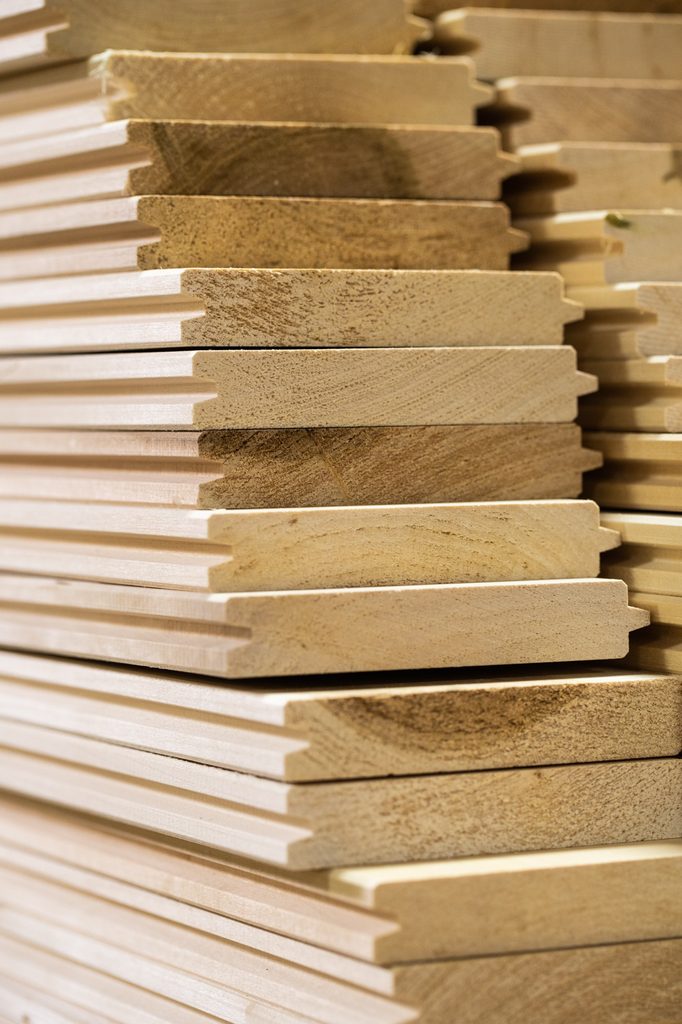
From a construction perspective, basswood holds its shape through repeated heating and cooling cycles, resisting the warping and cracking that affect many other woods.
SaunaRay chooses basswood for all these reasons. Our wood never crosses a border, never requires fumigation, and never makes a round trip across the Pacific Ocean.
At SaunaRay, every sauna is built from solid Ontario basswood: no veneer, no plywood, no formaldehyde adhesive, and no fumigation. Your sauna is handcrafted in Ontario from basswood that grows in Ontario. That’s why we can stand behind it with a lifetime warranty.
Wood Comparison Chart
| Factor | Basswood | Cedar | Hemlock |
|---|---|---|---|
| Aroma | None (chemically quiet) | Strong (volatile oils) | Mild, but glue off-gasses |
| Health risks | None significant | Thujone (neurotoxin), plicatic acid (asthma) | Formaldehyde if adhesives are used |
| Food-safe | Yes, used for utensils | No, pesticidal wood | No, not food safe |
| Construction | Solid planks | Solid planks | Planks or plywood / laminate |
| Wood origin | Ontario / North America, never treated | Old-growth BC coastal | Canadian timber, shipped to China and back |
| Environmental impact | Fast-growing, renewable | Slow-growing, can be old-growth forests | Slow-growing, can be old growth |
| Best for | Infrared saunas | Traditional steam saunas | Low-cost imports |
The difference isn’t just the species; it’s the journey. Some brands use basswood but ship it to Vietnam or China and back. SaunaRay’s basswood never leaves home.
Find the Best Infrared Sauna Wood for Your Home
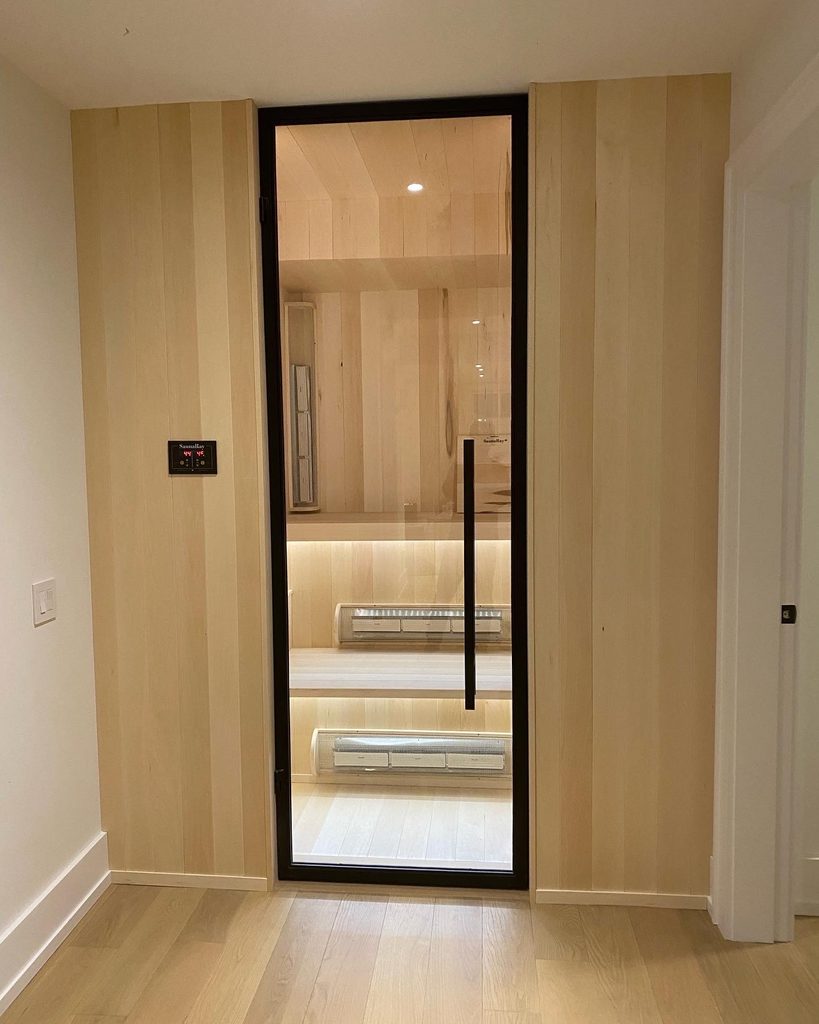
When choosing infrared sauna wood, look past the ads. The species affects what you breathe, how the wood handles repeated heating and cooling, and how much maintenance it requires. For a home sauna, solid basswood provides the best balance of clean air, durability, and long-term value, and when it never leaves the country, it also leaves the smallest footprint.
At SaunaRay, we manufacture every infrared sauna in Collingwood, Ontario, using solid Ontario basswood and medical-grade ceramic infrared elements. All exterior walls are finished with Canadian beeswax.
We have standard models that fit every size of room and custom options for special or unique spaces. To find the right model for your home, call 1-877-992-1100 or contact us online.
Frequently Asked Questions
Does the type of wood affect how an infrared sauna works?
The heater produces the heat; the wood determines what you breathe in and how the unit endures. A chemically quiet wood like basswood means clean air without off-gassed terpenes or formaldehyde. Heater placement matters too: corner-mounted heaters allow you to lean back comfortably, while wall-mounted heaters force you to sit forward on the bench edge.
Is aromatic wood better for an infrared sauna?
No, aroma means volatile compounds are entering the air you breathe. In a small, sealed, heated enclosure, that’s a caution, not a feature. Avoid plywood or fumigated wood in the construction.
Why is hemlock a sign the sauna was made in China?
Hemlock is the signature species of Chinese sauna manufacturing. Chinese factories openly advertise “Canadian hemlock,” importing BC coastal timber, building saunas in China, and shipping them back across the Pacific. If the spec sheet says hemlock, the factory was msot likely in China.
Should infrared sauna wood be treated or finished?
The interior should be left unfinished; the wood itself is the finish. Household stains, sealants, and lacquers off-gas when heated and have no place inside a sauna. Exterior surfaces may take a natural finish such as beeswax, which doesn’t off-gas the way chemical lacquers do.
What should I ask a manufacturer about sauna wood?
Ask about the exact species. Ask where the wood was harvested and whether it was shipped offshore for manufacturing. Wood that crosses an ocean is typically treated for pests and may be bonded into plywood or laminate. If the answers are vague, you’ve got your answer.
How long does infrared sauna wood last?
Solid hardwood planks finished to ¾” thickness (the standard in furniture that has lasted a century) will endure for generations. Plywood and laminate construction will not.